
Production allocation software · Oil & gas
Production allocation and reporting, from wellhead to reservoir.
One traceable system for operators who still allocate in Excel: measured production allocated back to wells and partners by a written accounting method, with every barrel traced to its meter reading. Built by the process engineers at FEEC, and being shaped with design partners.
Published pricing · Excel-first import · 2–4 week onboarding
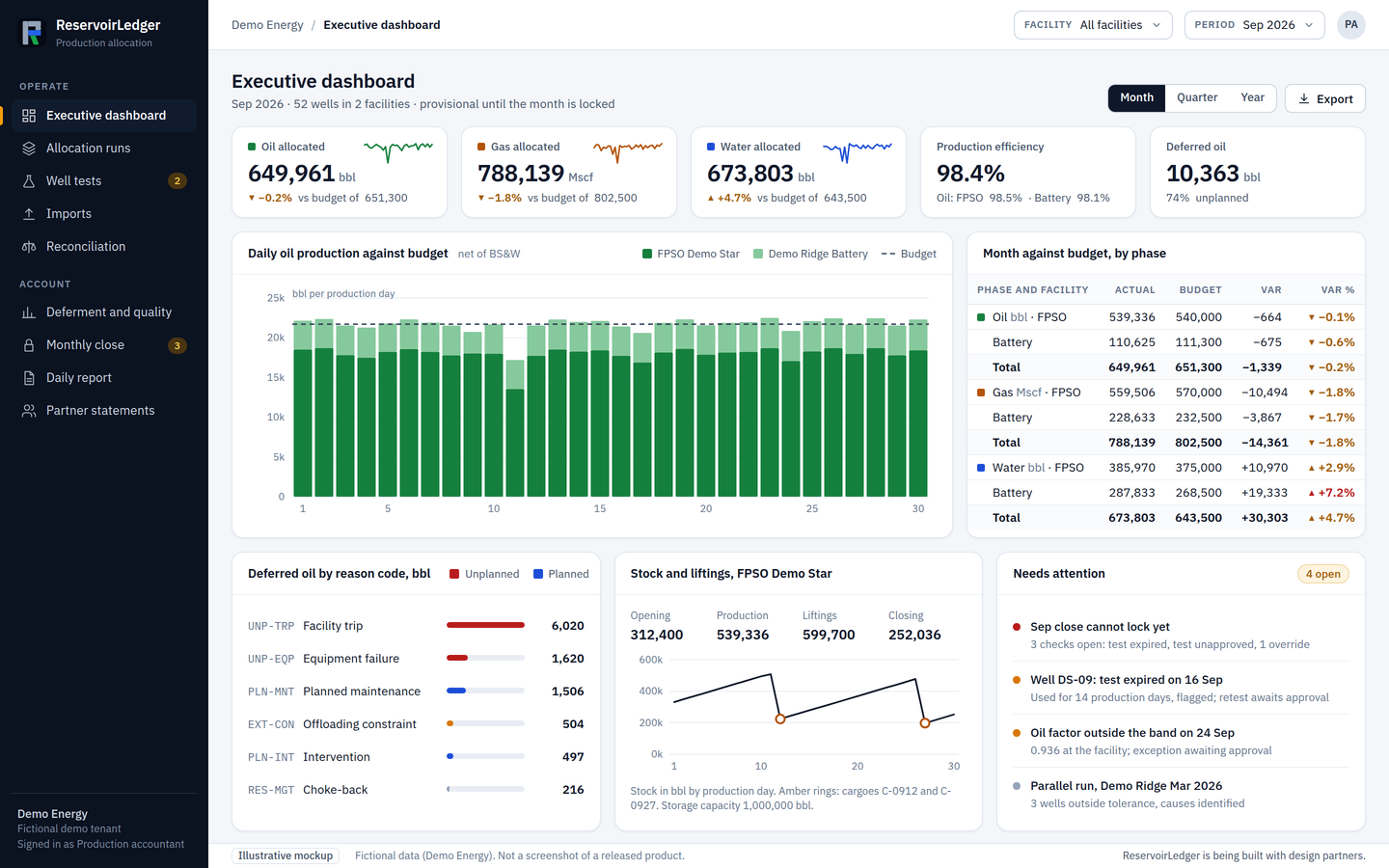
- Excel-first importTemplates that look like your DPR
- Daily allocationProvisional, then the monthly close
- Per-barrel audit trailMeter reading to report
- Dashboards and reportsNative units, boe only if configured
Where ReservoirLedger stands
The problem
Allocation outgrew the spreadsheet.
Excel allocation works until a partner, an auditor or the person who owns the workbook asks how a barrel was allocated, and by whom.
| Excel today | What ReservoirLedger is built to do |
|---|---|
| One person owns a fragile workbook; formulas break; key-person risk. | A locked allocation engine with a written accounting method that you sign, and golden tests. Anyone on the team can run the close. |
| The month-end close takes days; management sees the numbers late. | Daily provisional allocation, a Daily Production Report emailed every morning, and live dashboards. |
| Partner disputes, and no audit trail. | Every allocated barrel traces to its meter reading, well test, hours, factor and any approved override. Periods lock; changes are restatements. |
| Enterprise systems cost six to seven figures and take 6 to 18 months to implement. | Published pricing, 2–4 week onboarding, and Excel templates that look like your daily production report. |
| Fear of switching. | The parallel-run guarantee: we reproduce your closed month within the agreed tolerance, or the pilot fee is refunded. A full data export is available at any time. |
Built by FEEC
Built by process engineers, not a generic software shop.
ReservoirLedger is a product of Front End Engineering Consultancy (FEEC), an independent upstream and midstream engineering consultancy. The people designing the method are the people you talk to.
Process engineers, not a generic software shop
FEEC is an engineering consultancy for upstream and midstream facilities. Flow networks, well tests, fuel, flare and vent, and stock are the working vocabulary here, not features added afterwards.
A method you can read and sign
The accounting method is written down first: the algorithm per phase and node, the conservation rules, the exception policies and the tolerances. Your side signs it before any allocation is run.
Records that stand up to a partner
Each run stores its inputs, source files, well tests, factors, profile and engine versions, and the override and approval records behind it. A re-run supersedes a run; it never overwrites one.
Founder-led, with design partners
You deal directly with the engineers building it. One or two design partners shape the first release and get a discounted first year in return.
How it works
From your workbook to an approved monthly report.
Set up once from the workbook you already keep, keep entering data the way your team works, and let the engine do the allocation and the record-keeping.
- Step 1
Template
Start from an Excel template that looks like your own daily production report, rather than a screen to learn.
Excel-first
- Step 2
Import
Load the daily workbook: well status, hours on, well tests, meter volumes, tank gauges, injection, fuel, flare and vent, and deferment.
Daily facts · monthly close
- Step 3
Validate
Every row is checked before anything is saved, and the problems come back as an error report you can fix in Excel.
Nothing saved unchecked
- Step 4
Allocate
The locked engine allocates provisionally each day by the written method, back through your flow network, in native units.
Immutable, versioned runs
- Step 5
Review
Allocation factors and the balance are shown against the tolerance bands in the method, so an exception is visible the day it happens.
Tolerance bands from the method
- Step 6
Reconcile
Set the result beside your own spreadsheet, well by well, and see every difference with its reason.
The centrepiece of the pilot
- Step 7
Approve
Overrides need a reason and a second person. An approved month locks, and a later change is a restatement.
Second-person approval
- Step 8
Report
The Daily Production Report each morning, the monthly report, the allocation audit, partner statements and Excel exports.
Report profiles, not filings
Parallel-run guarantee
We reproduce your closed month, or the pilot fee is refunded.
The paid pilot sets our allocation beside your own spreadsheet, well by well. If your closed month is not reproduced within the agreed tolerance, after one remediation cycle, you get the fee back in full.
- Scope
- One facility, up to 25 producing wells, one allocation profile
- Duration
- 3 months from kick-off
- Success
- Your closed month or months are reproduced within the tolerance in the signed method
- Sign-off
- Your production accountant (or the owner of the spreadsheet) and FEEC sign the reconciliation report
- If not reproduced
- One remediation cycle, then the pilot fee is refunded in full
- Data
- A data processing agreement is signed before any data is shared. Without conversion, a full export is delivered and your data is deleted within 30 days
Pricing
Published pricing, by facility.
No ‘contact sales’ to find out what it costs. A plan is sized by facilities (allocation networks), each with a producing-well allowance.
- Essentials from $1,490/month: up to 2 facilities, 50 wells and 10 users.
- Professional $3,490/month: up to 6 facilities and 250 wells, with unlimited users.
- Enterprise from $6,990/month for larger estates.
- A 3-month pilot for $4,990, refunded in full if your closed months are not reproduced.
- Read-only management and auditor accounts are free on every plan.
FAQ
Questions we get asked first.
“Excel works.”
It does, until the person who owns the workbook is away, or a partner asks how a barrel was allocated. ReservoirLedger is built to keep Excel as the way your team enters data, and to replace the fragile formulas with a written accounting method that you sign, a trace from every allocated barrel back to its meter reading, well test, hours and factor, and an engine that anyone on the team can run.
“What about security?”
Tenant isolation is enforced in the database, not only in application code. Real customer data is held only on a dedicated production host that is pen-tested before any customer data is loaded, and backups are encrypted and restore-tested. We make no certification claims.
“You’re small. What if you disappear?”
You can leave with your data. A full export is available at any time: the original source files, the normalised data as CSV and JSON, every allocation run with its provenance, the allocation-profile versions, and the audit log with approvals. FEEC itself is an engineering consultancy that has been operating since 2020.
“Our case is special.”
Allocation profiles and a mapping wizard exist for that. The first profile is offshore test-based back-allocation over your flow network, followed by US onshore lease and battery allocation. The rules you write down, such as test validity and tolerance bands, become part of the method you sign before any allocation is run.
Is this a reservoir simulation or reserves tool?
No. ReservoirLedger is production allocation software: it allocates measured production back to wells and partners and produces the daily and monthly reports. It does not model reservoirs or estimate reserves.
ReservoirLedger by FEEC
Start with your current workbook.
Join the design-partner programme or book a demo. Tell us how many facilities you allocate, what you keep in Excel today and how long your month-end close takes.